It might not be the most popular travel destination in Italy, but Catania has much to offer its visitors: immaculate baroque architecture and ancient structures, narrow romantic streets, and a wide range of delicious and savoury culinary offerings.
Yet, Catania is a criminally underrated European city, despite possessing the same charm that makes other more popular Italian cities among the world’s most visited tourist destinations.
Catania is an excellent travel destination due to its moderate size and low travel costs, which allows visitors to experience a lot, quickly, and on a budget. Read this Catania travel guide and you’ll find everything there is to know about the second-largest city in Sicily, which I visited on a three-day trip.
Essential Things to Know Before You Visit Catania
Here are a few handy tips to know before visiting Catania, covering important details such as location, weather, language, money, and much more.
Location
Catania is located in Eastern Sicily, near the base of Mount Etna, an active stratovolcano. Though Mount Etna erupts frequently, the volcano has not impacted the city since 1669, though travel advisories and cancelled flights are known to occur. Be sure to stay updated with your airline and pay attention to local alerts before visiting.
Public Transportation
Catania has a reliable transit system and, surprisingly, offers an underground metro train in addition to reliable public buses. Local transport in Catania costs approximately €0.80 and can take you to most places of interest.
You can take Catania’s public airport bus to and from the airport, which runs frequently and drops visitors off on Via Etnea in the city centre. Sicily also offers an intercity train network from Catania Centrale station, which can take you to other cities fairly quickly and cheaply, such as Palermo, Taormina, and Syracuse. For example, Catania to Palermo can cost as little as €20.
Ride Shares and Taxis
Ride-share apps like Uber are available in Catania and other major Sicilian cities.
Travellers should avoid hailing cabs due to their reputation for overcharging tourists. If you need a taxi, call a dispatcher or have your hotel arrange a ride with a fixed price agreed upon beforehand.
Walkability
Walkability isn’t one of Catania’s strengths, as the city can often be hilly and you’ll frequently find yourself walking uphill. That said, the city centre itself is fairly walkable, and many points of interest are a short distance from one another.
Money
Sicily is part of Italy and therefore uses the Euro. ATMs and banks are available throughout the city.
The Banca Nazionale del Lavoro is part of the Global ATM Alliance, which means members of affiliated banks can withdraw money for no fee, usually at a good exchange rate. If you’re a customer of Bank of America (USA), Scotiabank (Canada), Barclays (England), or Westpac (Australia), you’ll be able to withdraw funds here. Credit cards and mobile pay are accepted at most places, but not everywhere — it’s best to have cash on hand for old-school cafes and small businesses.
Language
Most people in Catania do not speak English, which makes an offline Italian-English dictionary very useful. Be sure to download one before visiting for offline access if you don’t have cellular service in the country. Some Catanians may speak French or Spanish, which can come in handy.
Health and Safety
The public emergency number in Catania is 113.
Catania is a very safe place to visit. Be sure to take regular precautions, though you’re unlikely to experience any negative interactions. Pickpockets are known to operate around the city, and some areas can get rowdy at night. Pharmacies are available throughout the city and can be identified by green medical cross signs. Take particular care when crossing the street, as traffic can be quite chaotic.
SIM Cards and Cell Phones
Like other countries in Europe, SIM cards are affordable in Catania and can be purchased at the airport and throughout the city for as little as €15.
Alternatively, eSIM company Airalo offers virtual SIM cards for much cheaper, starting at $4 USD — a great option if you’re familiar with how eSIMs work.
Best Areas to Stay in Catania
The best area to stay in Catania is the city centre, also known as Catania Centro, which puts you within walking distance of many points of interest.
Other great places to stay include anywhere along Via Etnea, Corso Italia, and the seafront, all of which are safe bets for great locations.
Things to Do and Places to Visit in Catania
Below, you can learn more about the many attractions, which include UNESCO World Heritage sites, day trips, beaches, and more.
1. Piazza del Duomo
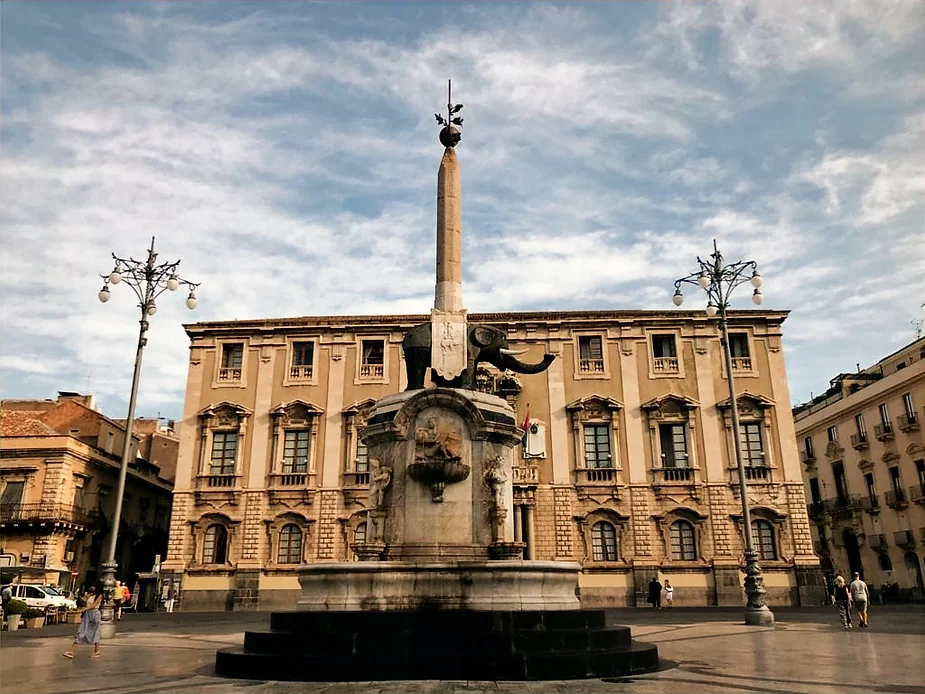
Piazza del Duomo (Cathedral Square) is Catania’s main square. Though it shares a name with famous squares in other Italian cities like Florence and Milan, Catania’s version has its own unique attractions, including the Basilica Cattedrale di Sant’Agata and the Fontana dell’Elefante.
This is one of the best places to start your trip in Catania, as many points of interest are located within or near the square. It’s also an exceptional place to enjoy breakfast, with cafes serving food throughout the day.
There is also an annual festival for the Feast of St. Agatha, which takes place in Piazza del Duomo, usually at the beginning of February. Those who attend can expect religious processions and celebrations, entertainment, and fireworks honouring the patron saint of Sicily.
2. Fontana dell’Elefante
Elephants are symbols of Catania and can be seen on everything from souvenirs to the remarkable Fontana dell’Elefante (Elephant Fountain) in the Piazza del Duomo, adjacent to the Basilica di Sant’Agata.
The statue was constructed in 1736 out of volcanic rock and lava stone, giving it a uniquely dark colour — the same material used to build many of Catania’s sidewalks. Visit the fountain and introduce yourself to “u Liotru,” the jovial elephant sitting atop an Egyptian obelisk which, according to legend, possesses magical powers.
3. Basilica Cattedrale di Sant’Agata
Saint Agatha, the patron saint of Sicily, was born in Catania and also died there. The Basilica Cattedrale di Sant’Agata was erected in her honour and stands in magnificent wonder in the Piazza del Duomo today. The cathedral’s origins date back to the 11th century and it has experienced significant damage from earthquakes over the centuries. However, it has remained untarnished since the late 18th century, drawing from Norman and Baroque architectural styles, with an equally impressive interior.
4. Castello Ursino
The Castello Ursino, also known as the Piazza Federico di Svevia, is a castle built in the 13th century. It holds significant historical significance as the setting of the Sicilian Vespers, and has served as a royal residence and a jail before becoming the tourist attraction it is today — a must-visit if you find yourself in Catania.
5. Catania Fish Markets
Catania’s fish markets are a unique staple of Sicilian culture, with one of the busiest and most joyfully chaotic ones located in Piazza Carlo Alberto. These outdoor merchants offer a genuine look into Italian life: eccentric and noisy, bustling with vendors selling fish, seafood, fruits, and vegetables.
The market is open Monday to Saturday, from 7:30 AM to 12 PM, and closed on Sundays. One of my biggest travel regrets was not purchasing fish and having it cooked at the market — be sure to do so if you find yourself there.
6. Orto Botanico dell’Università di Catania (Catania Botanical Garden)
The Orto Botanico dell’Università di Catania is a botanical garden maintained by the University of Catania’s botany and horticulture department. Operating since 1856, it is located within walking distance of the city centre and is made up of two sections — one dedicated to Sicilian plants and the other to exotic and international species — with a marvellous fountain with fish swimming within it. There is no admission fee, making it an ideal spot for budget-conscious travellers.
7. Teatro Romano (Roman Theatre of Catania)
Over time, Mount Etna’s eruptions have been responsible for destroying much of Catania. However, the Teatro Romano has stood the test of time, remaining intact since approximately the second century. A Roman amphitheatre influenced by ancient Greek theatre, the Teatro Romano is accessible to the public and free to visit during the day.
8. Piazza Teatro Massimo Bellini
Another beautiful square in this endlessly brilliant city, the Piazza Teatro Massimo took over two hundred years to complete, partly due to a disastrous earthquake that damaged much of the town. Visitors can expect to find the Teatro Massimo, named after composer Vincenzo Bellini, who debuted his magnum opus, Norma, there in 1831. The theatre seats 1,200 and still hosts performances to this day.
9. Giardino Bellini
The Giardino Bellini is a picturesque garden featuring a large water fountain with plenty of places to sit, people-watch, and enjoy the views. Scenic walks throughout the garden can make an afternoon fly by. Entry is free and the garden is easily accessible from Via Etnea, making it the perfect green escape in this charming and busy city.
Day Trips from Catania
Catania is great, but there is a lot to explore in neighbouring cities — and even countries — all within reach for day trips. If you spend a few days in Catania, consider visiting other Sicilian destinations such as Mount Etna, Palermo, and the breathtakingly beautiful town of Taormina, all accessible by train from Catania Centrale. Tickets are inexpensive and trains run on a frequent schedule.
Taormina, Sicily
Taormina is a peaceful hilltop town brimming with beauty and natural serenity. It also played a significant role in the movie and novel The Godfather, as well as season two of the HBO series The White Lotus.
You can catch a train from Catania Centrale that takes around an hour. Once you arrive at the Taormina train station, you’ll need to buy a bus ticket to take you up the hill to the town — don’t even think about walking up, as it’s a winding and dangerous road. Taormina offers charming views, delicious food, street performers, and ancient structures. Well worth a day visit.
Mount Etna
The city of Catania and Mount Etna have a uniquely strange relationship. The volcano has caused a great deal of damage to the city over the centuries, but has also provided volcanic ash that makes the local soil especially fertile. While eruptions have happened recently, it remains an excellent and safe place to visit. A UNESCO World Heritage Site, visitors can take bus trips and gondola rides up the stratovolcano to enjoy extraordinary views.
Coach buses leave from the parking lot outside Catania Centrale every morning and operate on a first-come, first-served basis — if you miss it, you miss it for the day. Bus drivers accept cash, debit, and credit cards. Alternatively, you can take a taxi, Uber, or rent a car, though these options can be more expensive.
Palermo, Sicily
Palermo is the capital of Sicily and the largest city on the island, approximately three hours from Catania by train. Visitors can spend time at the Catacombs of the Capuchin Monastery or the Teatro Massimo opera house, while indulging in the city’s mouth-watering street food. Add beautiful baroque architecture and art, and you have the wonderful city of Palermo.
Malta
Malta is an island off the southern coast of Sicily with a unique culture distinct from Italy, though heavy Italian and Arabic influences can be seen across the island.
There are many day trip options available. Ferries typically leave Catania in the morning for Valletta, returning late in the evening. Travellers can also book a short flight to the island, though this can be costly for a day trip. I visited Malta by plane from Catania and wish I had taken the ferry instead — it cost me around $250 CAD for a 20-minute flight with over an hour of check-in time. Live and learn!
Food and Drink to Try in Catania
Italian food is one of the most celebrated cuisines in the world, so when you find yourself in Catania, don’t miss out on the Sicilian variations of these world-famous dishes. Catania is known for fine dining, casual dining, and street food — try to experience all three.
Sicilian Pizza (Sfincione)
Pizza options are abundant in Sicily at sidewalk cafes and upscale restaurants alike. However, Sicilians are proud to offer their own variation: Sfincione. A thick-crust Neapolitan-style pizza with a unique sponge-like texture, Sfincione is topped with tomato sauce, cheese, onions, olive oil, and breadcrumbs.
Pasta
There’s no shortage of pasta in Sicily, but be sure to try Pasta alla Norma — a Sicilian variation containing tomatoes, eggplant, and ricotta salata cheese.
Arancini
Arancini are savoury deep-fried rice balls coated in breadcrumbs and filled with ragù sauce, mozzarella, and peas. A famous Sicilian street food beloved by locals, they are also served in fine restaurants.
Granita
Think of granita as a slushy take on gelato, with various flavour options and toppings. If you’re visiting in the summer months, this refreshing treat is hard to miss — and it’s particularly popular in Taormina as well.
Cannoli
Although many associate the cannolo with Italian food in general, this iconic pastry actually originates from Sicily. Enjoy these crispy shells filled with sweet ricotta and garnished with chocolate chips, pistachios, or other variations.
My Final Thoughts: Visit Catania, Sicily
Catania is overlooked and underrated. Visitors who make their way to this city will not be disappointed — it’s an excellent introduction to Sicily and Italy, capturing much of the beautiful country’s best offerings.
Catania is one of Europe’s most unique hidden gems and is certainly worth a visit. My only regret was not spending more time exploring Sicily. However, I plan to return and will certainly revisit Catania the moment I get the chance.
FAQs about Visiting Catania, Italy
Is Catania worth visiting?
Yes. You can visit most of the city within a day or two. Be sure to plan for day trips, as nearby attractions are just as exciting.
Is Catania safe?
Yes. Catania is safe. Be aware of pickpockets and scams in crowded areas, and cross streets with caution, as traffic can be quite chaotic.
How much time should I spend in Catania?
It depends on your schedule, but one night will give you a taste of the city. Two nights will allow you to also visit places like Taormina or Mount Etna.
Where can you swim in Catania?
Catania has many public beaches for visitors and locals alike. Some popular ones include Playa San Giovanni Li Cuti, La Plaia, and Playa San Paolo.
Related Travel Guides
